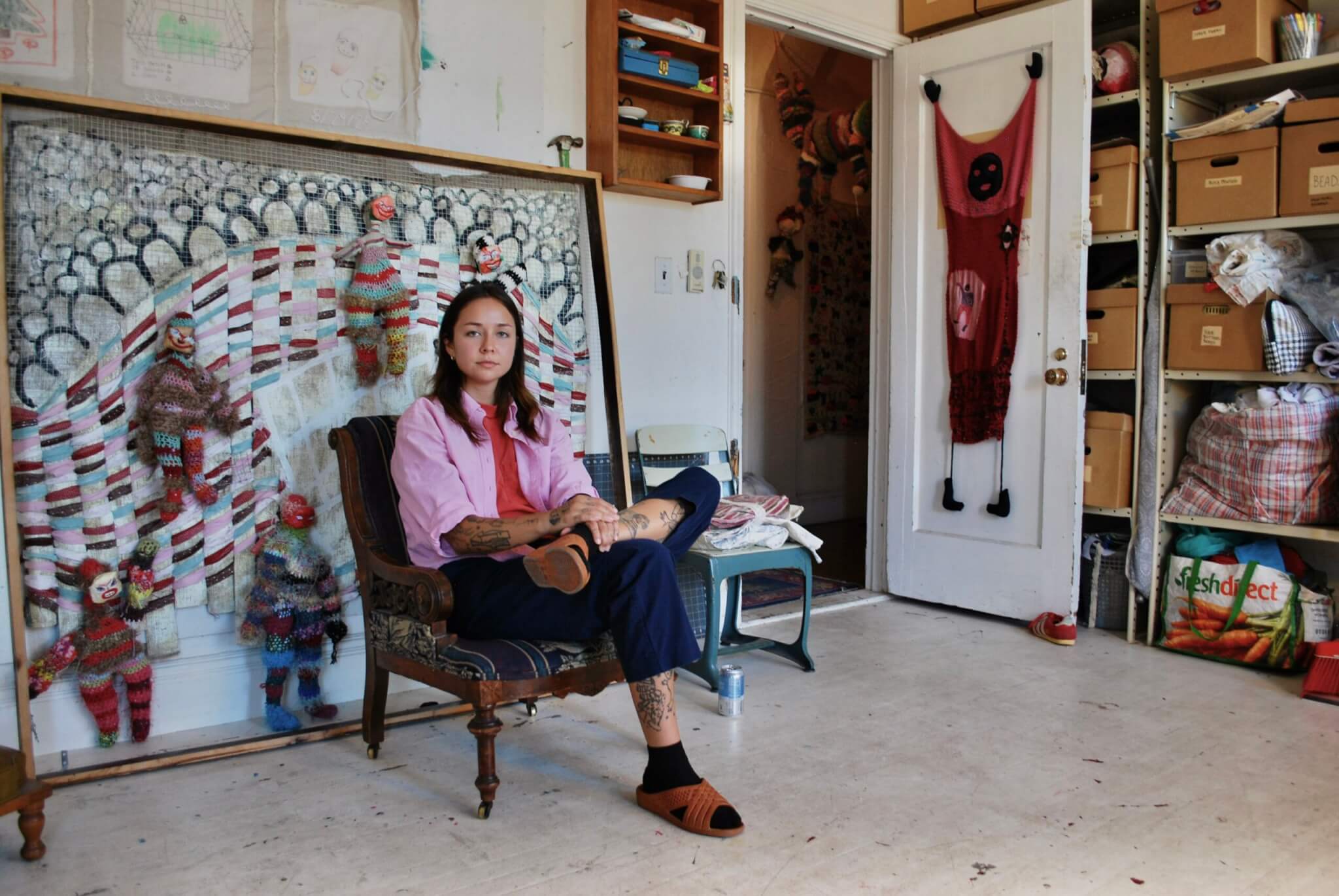
Celeste Diaz Falzone finds inspiration everywhere. A mixed-media artist, her works start as illustrations before becoming large sculptural knit and crochet pieces. Her current show at the Distillery Gallery is an amalgamation of her personal favorite works created over the past few years—more than thirty are on view. After the opening of her solo exhibition, I visited her at her home and studio in Pawtucket, Rhode Island, where she lives and works in a space stewarded by a handful of other artists and makers. Previously vacant, Diaz Falzone and her friends have fixed it up in a DIY fashion, converting it into a multipurpose space. Inside her studio, Diaz Falzone decorates with past experiments. Handmade quilts adorn the couch. A sheet of canvas lies on the floor with stuffed crochet heads and fabric bodies stitched on top. The space includes the two extreme ends of Diaz Falzone’s scale: Old drawings in small frames lean against one wall, while wingspan-length tapestries occupy another. When I spoke with her, we discussed the power of writing, creating intuitively, and how spirituality influences her artistic practice.
Rene Zhang: You and your friends put a lot of work into making this space your own. What do you find most valuable about sharing it with the other artists here?
Celeste Diaz Falzone: I mean, I wouldn’t be able to live in this place otherwise. People are handy in ways that I’m not. I would never be able to deal with electric, plumbing, tiling. It’s amazing having people who are handy around. And then it’s always nice seeing what people are working on and being around people that are very movement oriented and doing their stuff. It keeps me in a good head space. We’re all here because our work is number one.
RZ: What excites you the most about working in Pawtucket right now?
CDF: I love Pawtucket. People have great style. I have never seen so many unique outfits. People are very original here in a way that I think is notable. If you spend a lot of time here, you’re like, Whoa, we’re in some kind of astral plane where people are between other realms or on some type of a spiritual highway or something. There’s definitely an energy. There’s a high vibration here.
RZ: You’ve been fairly open about being a self-taught artist, meaning you didn’t go to art school. What first drew you to making things by hand and how did this textile practice become central to your work?
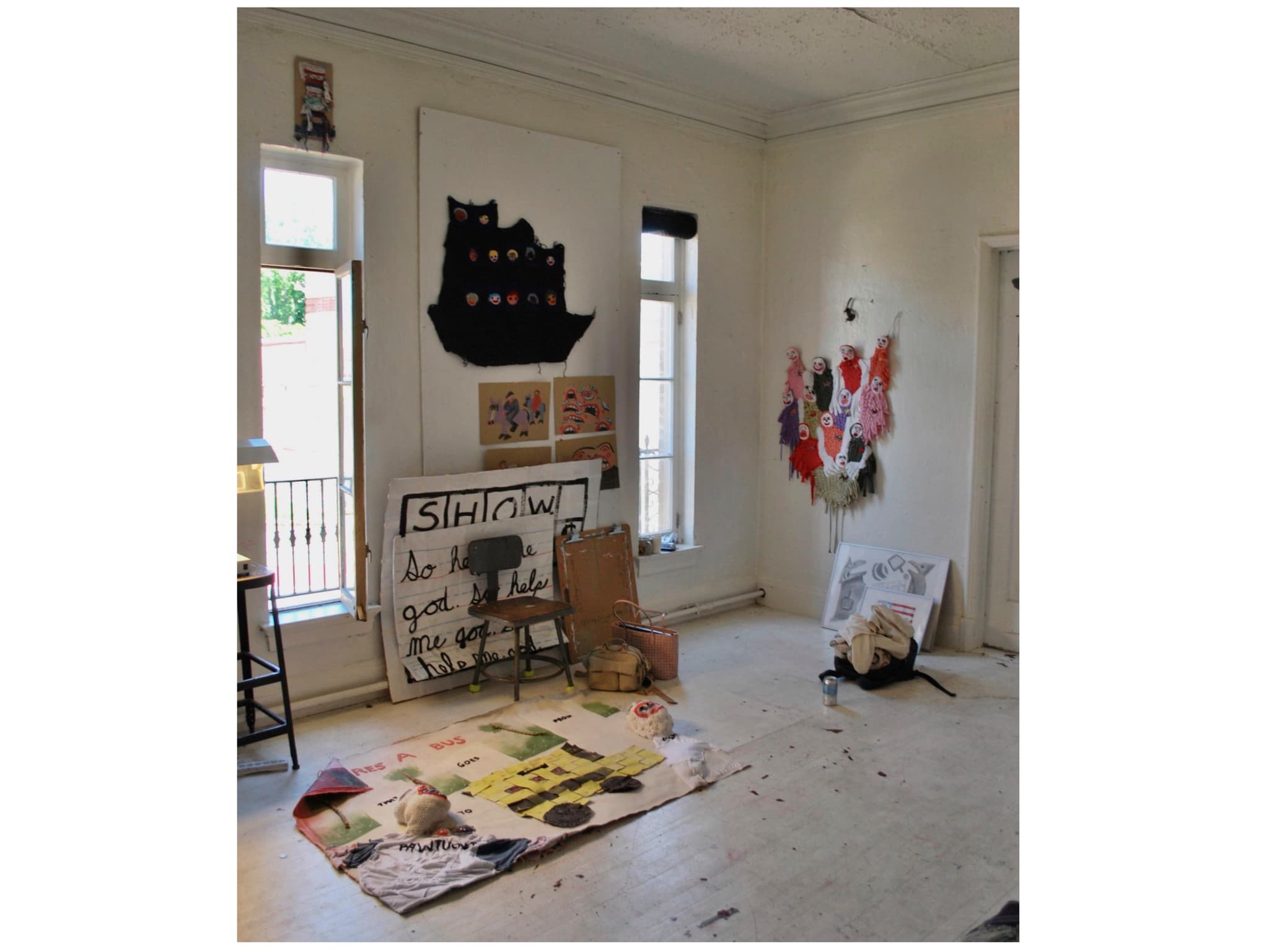
Celeste Diaz Falzone’s studio in Pawtucket, Rhode Island, June 2026. Photo by Rene Zhang.
CDF: “Self-taught” always feels like such a funny word. I almost wish that there was a better word for it. It just means taught by many different people in different places over a random amount of time. So I feel very educated by the people around me in different experiences. My friend Michelle, who’s super talented, taught me how to crochet. I learned that maybe five years ago and just really ran with it. I had learned to knit when I was in eighth grade. Sometimes in high school I would do it occasionally, but it wasn’t until after I learned to crochet and realized it allowed me to be sculptural that I started reincorporating knitting again. But the base [of the work] is in illustration because I always kept a drawing book. I think crochet was the first thing that made me put two and two together. Like, you can actualize these drawings into form.
RZ: Many of your pieces are knit or crochet, and they’re figural with variable proportions on them. How do these pieces come together? You said they start with illustration, but do you usually come up with a pattern or a sketch?
CDF: Not at all. I’m learning as I go and it’s always like, “I wonder if I’m going to be able to make that shape,” and I start and then I look back and I’m like, “How’d that happen?” I couldn’t do it twice [laughs]. I feel like that about every piece—I couldn’t do it twice. The furthest extent to which I can plan is the color palette that I want to use and a rough idea of the image, but anything beyond that, I really can’t. Even to scale I can’t plan. I make a piece and I’m like, Oh shit, this thing’s going to be big.
RZ: For your current solo exhibition at the Distillery Gallery in Boston, there are more than thirty pieces on view that you describe as your favorite works over the past few years. What makes these pieces so special to you and why did you want to show them all together?
CDF: It’s just that thing of like, Oh, these came out great, you know? All the work comes from drawings, and sometimes I feel it translates perfectly into the sculpture and I’m really happy about that. But sometimes the drawing is just a starting point and the sculpture ends up being something totally different and that’s equally welcome. I really don’t want to force something into existence. Sometimes I will really be forcing something to look like the drawing, and it hinders the work. Or vice versa—going in too formless and not having a strong foundation to build off of. When it feels like I’m making thoughtful choices at every step, that’s when I’m really happy with the work. So I feel like these works were a good combination of both of those outcomes being respected and working out well.
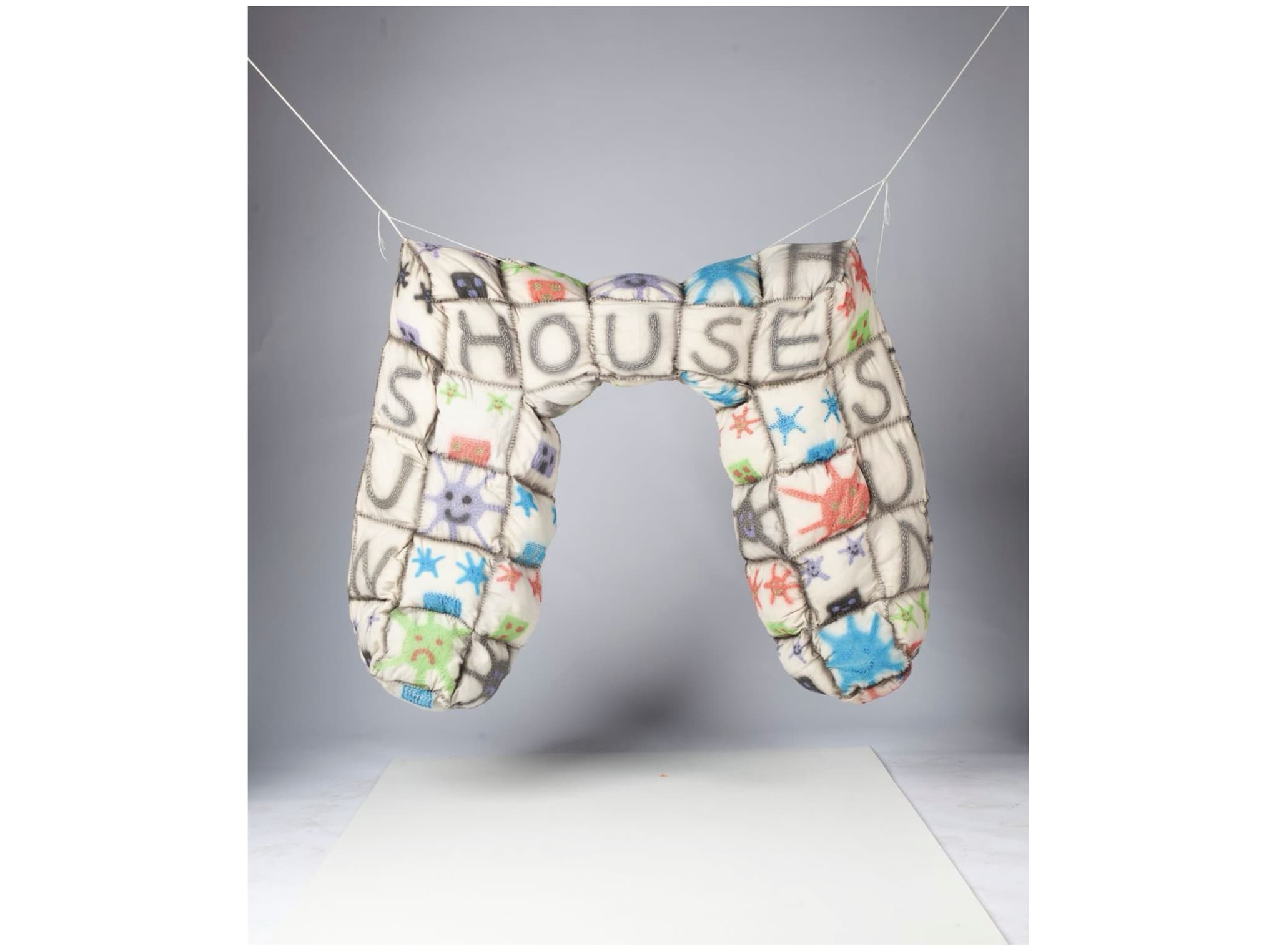
Celeste Diaz Falzone, HERE’S THE SUN, IT’S ON THE HOUSE, 2024. Mixed media, 48 x 39 x 15 inches. Image courtesy of the artist and Distillery Gallery.
RZ: Many of your works also include text, either stitched into the composition or included as a caption on the label. What is the significance of this writing to your artistic practice?
CDF: I’ve always loved writing. It’s been a very powerful form of expression for me. I really learned how to read and write when I was twelve years old. I was not really in school previous to that. Writing’s always been powerful because I think there was a before and after of knowing how to write, and I think I really wanted to express myself in that way growing up. When I was starting off and drawing in journals, I would often have poems, jokes, phrases stuck in my head. The phrases that you see in my work that I incorporate now or the descriptions are just things that I write in my journal. I’ll pair something that I write in my journal around the same time that I drew something. And if that drawing becomes a sculpture, I put it with the words if I can because something was happening and those things were related.
RZ: Have you ever been interested in long-form writing?
CDF: A little bit, occasionally. It’s a little tiresome to me, but I’m always glad that I did it. I’m very inspired by the writer David Sedaris. He’s published diary entries and also longer essays, and I’m really inspired by that style of documentation of life. I feel like I do that primarily through the creation of art without words, but when words come up, I just feel so thankful because I really admire and love words.
RZ: In terms of your writing and your imagery, is there anywhere else that you’re drawing inspiration from?
CDF: It’s all just daily life. I really try to be a documentor of observations in the world around me and being a human being with past experiences and a perspective. Myself and my view always come through, but I really try to minimize that and have it be as objective as possible. I really just want to document and report the things in life that stand out to me and I feel are poetic on some level. Something small and mundane that speaks to a large truth about the universe, something in style or culture that feels so current but says something about all of time—the things in life that maybe you don’t understand but they catch your attention.
RZ: On your website you describe your art-making process as communing with God. Can you say a little bit more about this experience?
CDF: I mean, God can be such a tricky word for people. But to me, God represents this feeling of knowing more than you understand, seeing more than you know how to express. In making art, I’m never going to be able to express the unspeakable things that you’ve seen or felt. But I’m always going to try to render it in some way because it feels important, like transcribing a message so it comes up in all different ways. I dream super intensely and that’s a very powerful force. It feels like half my life is dreams, and I often get dreams confused with memories. So these dreams, these experiences that aren’t physical and tangible, I want to highlight because they are just as real as the tangible to me—if not more—because they’re expansive. It feels powerful to bring the intangible into the tangible, or at least attempt to.
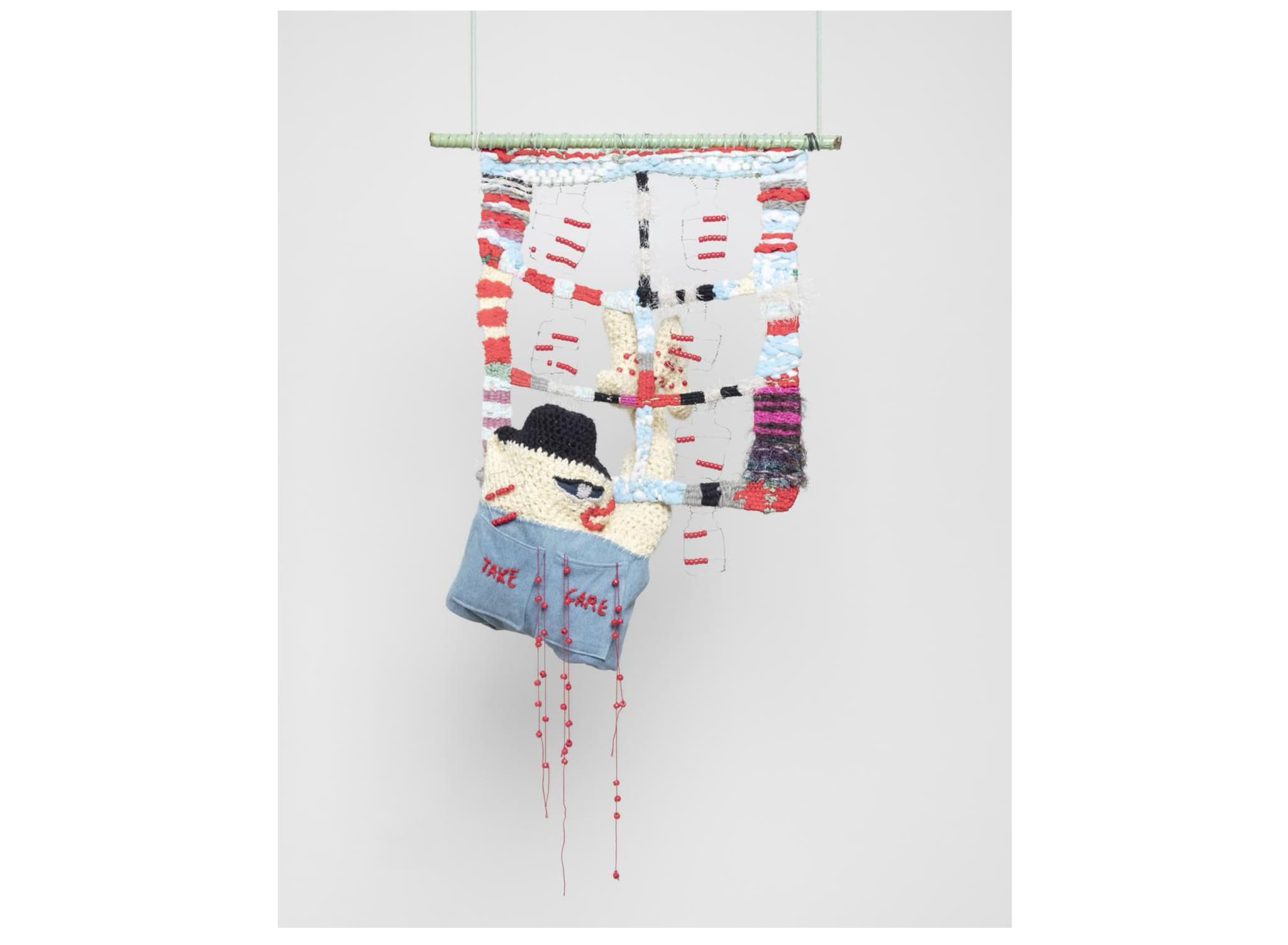
Celeste Diaz Falzone, TAKE CARE, 2026. Yarn, wire, beads, rope, embroidery floss, fabric, steel, bar, 38 x 19 x 8 inches. Courtesy of the artist and the Distillery Gallery.
RZ: Do you think that also translates into how people are experiencing your art?
CDF: I hope so. I really hope that it opens people up. I come at this with as little thought as possible and as much intuition as I can. I really hope to open up that space in people to put down their thinking mind. I want to get people into the space of knowing, whatever that is for them.
RZ: You also produce clothing and wearable objects that share visual and conceptual language with your artworks. What changes when the work enters everyday life through fashion rather than through “fine art”?
CDF: When I came to doing art full time, I needed a way to sustain myself in the beginning and the clothes felt like a really good way to do that. I used to make earrings and sell them door to door and I was very comfortable with that transactional type of encounter. It felt very fun, like a game. It’s the same with my clothes, which show what I do a little bit as an artist and have some level of that game-like transaction in there. So the clothes have been really great but feel a little separate from the work.
RZ: Looking ahead, are there any ideas, projects, or directions that are feeling particularly exciting to you right now?
CDF: I’m wanting to do a series of images on sheer fabric, which I’ve never done, almost drapey stuff. Last week I sewed together some burlap and was embroidering on top of it and thinking, “I’ve never really made dolls this way.” So I think I’m also going to be doing some more images on burlap and seeing where that can go. And then also when I was falling asleep last night, I thought, “You need to do some big drawings. You always just focus on small drawings and do big work.” I think doing big drawings would really open something up.
RZ: Would you ever make a big drawing and then little work?
CDF: It’s funny. Yes. I mean, I guess that’s kind of what’s happening with these dolls that I’m making right now. I think the instinctual thing is always to draw small and then work big. But I want to switch it up, flip them. We’ll see what comes.