Civic Culture Aug 20, 2026

ArtWonk: Is Art Media Finally Getting a Seat at the Journalism Table?

BAR hit the road on the 2026 journalism conference circuit, attending convenings hosted by Investigative Reporters and Editors, Momus, and the Knight Foundation. There, we found cautious signs that arts journalism and its infrastructure may finally be entering broader conversations about the future of media.

News by Kim Córdova

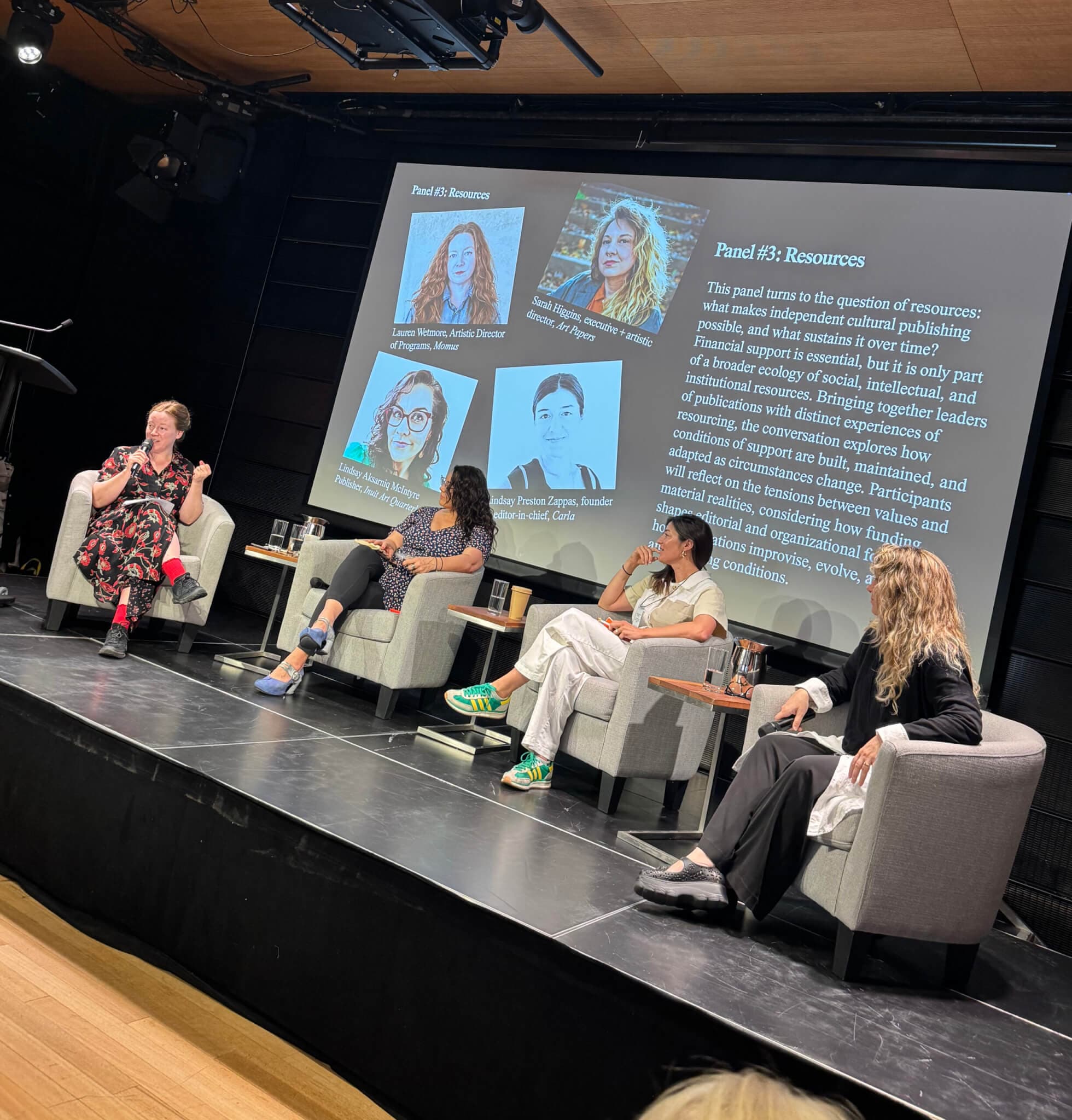
Four panelists converse, seated in front of a screen on a stage.

“Resources,” a panel at the Momus convening for independent arts publishers in Montreal, featuring the Inuit Art Foundation, Contemporary Art Review Los Angeles (CARLA), and Art Papers, and moderated by Momus.

Mid-August in Boston is a transitional season. Students and faculty are trickling back, but the pace is still slow—and the news is even slower. It seems as good a time as any to share what we’ve been up to this summer. 

This June and July were a first for the Wonk. I’ve been writing about art for more than a decade, but this was the first time I was invited to a journalism conference. Since the universe has zero chill, I was invited to attend not just one conference but three—all within four weeks. I attended the Investigative Reporters and Editors (IRE) conference as a fellow, the Momus convening for independent art publishing as a panelist, and the Knight Foundation’s conference on audience engagement. 

These invitations were heartening because they signaled a shift that might be underway: a recognition that art publications tend to fall through the cracks of awareness and infrastructure, both as members of the arts and the press.

Members of the art press are the third-culture kids of the art and media worlds: too arty to be “real” journalism outlets, too media-y to be arts organizations. The irony of being considered neither is that our work requires us to be both. As Mary Louise Schumacher has written, art “is often a lens through which debates that occupy the country—about race or gender, for instance—are seen.” Read this way, our job as arts journalists is to connect artists’ aesthetic decisions to both the news and history. 

As colleagues from local and mainstream media discussed the challenges they face and how philanthropy has been supporting them, I realized how our proximity to the culture field creates unique risks for us. A main challenge is that the value we contribute—publishing about artists and exhibitions—doesn’t circulate back through the system in ways that support art media, even though our work has a much longer “tail” than other types of articles, as it becomes part of artists’ CVs and the public record for later scholarship.   

Succumbing to these dynamics, Art Papers officially closed earlier this year. So did Variable West and 4Columns. Mainstay publications are also reducing their arts coverage. For example, our local paper of record, The Boston Globe, reprinted an AP story to cover the “Olympics of art,” the Venice Biennale, rather than send or commission a reporter. Year over year, fewer outlets publish documentation, news, and analysis about cultural life. Katherine Maher, CEO of NPR, has testified to Congress that among the societal good local journalism contributes, cities with access to local public media have higher rates of civic engagement, greater societal cohesion, and economic advantages, including better municipal bond ratings. Art journalism is part of that local media ecosystem. So when art publications disappear, it puts civic cultural life and the arts sector, both within the communities these publications cover and beyond, at risk. 

During the Momus convening (supported by the Canada Council for the Arts, the Dorothea and Leo Rabkin Foundation, Critical Minded, and the Terra Foundation for American Art), a panel featuring CARLA, the Inuit Art Foundation, and Art Papers shared numbers highlighting the resources these nonprofits need to keep producing their respective magazines. The amount needed to keep the projects running is small. Lindsay Preston Zappas, founder of CARLA, discussed the difficulty of driving memberships and donations, noting, “It’s hard because we are showing so much love for the community, and sometimes it feels like the community doesn’t love us back.”   

A report by the Rabkin Foundation, which presented the results of an early 2026 survey of 141 independent arts publishers, found that the average operating budget of these independent publications was just $181,000. “Foundation and philanthropic grants are one of the largest categories of financial support for these publications,” but they are also the largest source of funding decline, with 41.9 percent of publications reporting a decrease, the report noted. Worse, the report found that of the publications experiencing a decrease in foundation and philanthropic grants, 76.9 percent feel their current business model is not sustainable. This financial precarity, the report noted, leaves publications vulnerable to censorship. The survey results also refuted the suggestion that arts publishing is too niche or elitist, finding that the growth rates of art publication audiences are exceeding those of general-interest media.   

Three conferences in four weeks didn’t come out of nowhere. It’s often hard, if not impossible, to know whose invisible hand cupped a whisper to which philanthropic ear. BAR’s inclusion in these events is likely the result of sustained work by the Regional Art Publishers collective—of which BAR is a founding member, along with Burnaway, CARLA, Glasstire, and the now-defunct Variable West—and by grantmakers Critical Minded (of which I’m a fellow) and the Rabkin Foundation. Both funders have been working to address structural barriers that hinder arts journalism and prevent writers from marginalized communities from entering the field.  

Those of us who come up through arts education are trained to write about art, but we are less likely to be trained to understand the business of media companies—much less how this business is changing in a post-literary society. Critically, we don’t have networks of journalists at legacy publications to turn to for help because our corner of the media is so atomized and isolated. As we look to navigate these new paradigms of reader behavior—through social media news consumption, the turn to video, and the omnipresence of AI slop—we need to figure out how to sustain operations through a balance of earned income and philanthropic funding. But crafting a message that drives both is necessary. Sarah Higgins, executive and artistic director of Art Papers (until the end of the year), noted during the Momus panel that “Art Papers became a victim of the outside perception of its success.”  

For writers, there are also structural problems. Curators are invited, expected, and encouraged to write in leading outlets. It’s decidedly far less common to see writers curate at institutions. Arts publishing, in general, serves as a staging ground for arts workers to increase their personal brand visibility and leverage it into their next role. But within arts publishing, mobility is limited. Generally speaking, the going rate for the industry-standard 800-word review hasn’t budged in years, sitting at around $250 to $300.
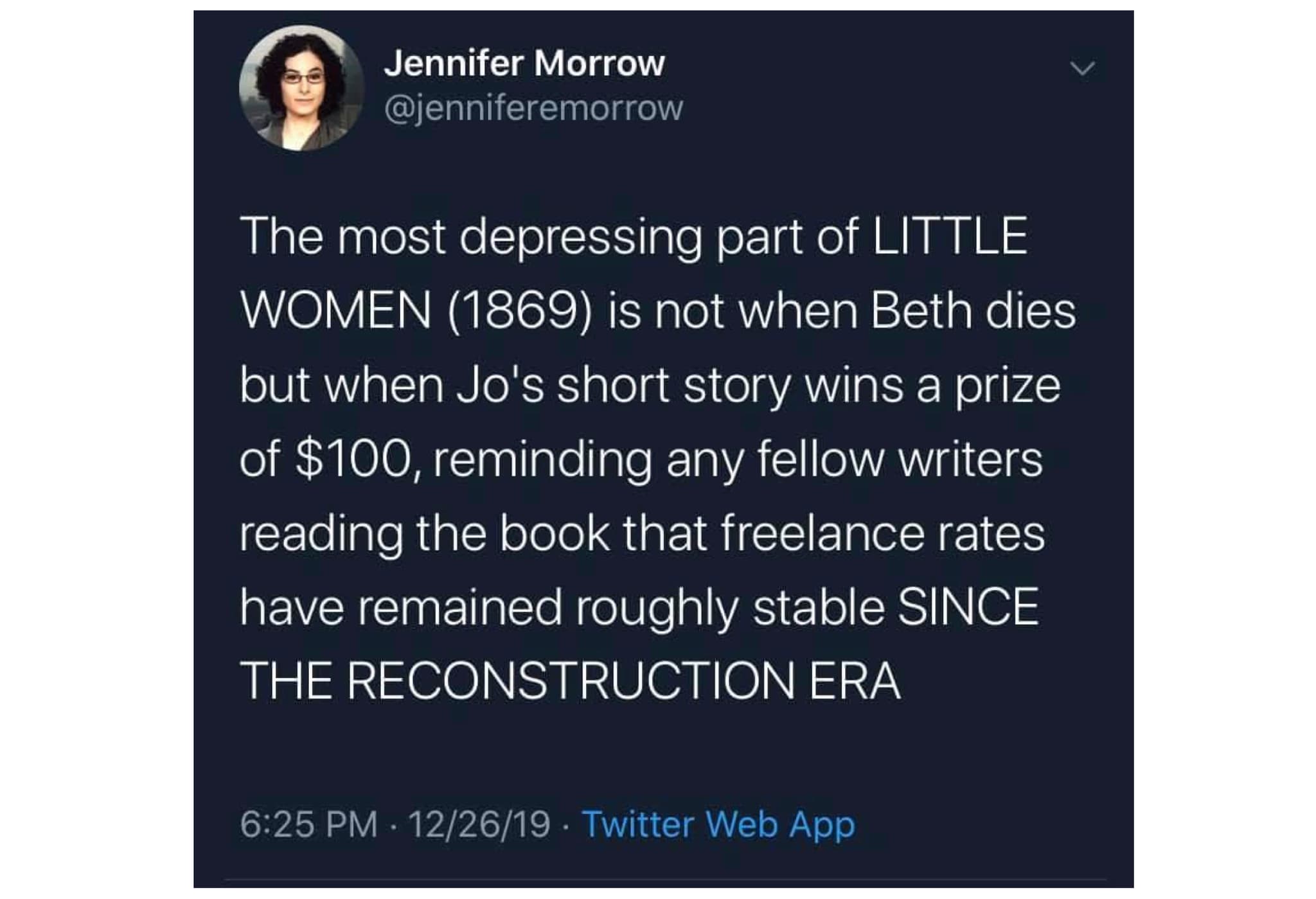
A meme from 2019 highlighting how local author Louisa May Alcott prefigured writing rates…forever? Note: BAR is committed to paying writers fairly, and we do pay more than Reconstruction-era rates.

The labor crisis in arts publishing is connected to the labor crisis in the arts writ large—and to labor in general. The gap that arts reporting falls into points to a broader problem: Labor, skills, and value production in the arts are misunderstood and largely illegible to the wider market. 

This summer, I came across a Substack article by a UK-based art advisor that hit me hard. Titled “Qualified for Nothing,” it focuses on how common it is for artists in their 30s and 40s to realize they need a day job beyond teaching, and on how, when trying to enter the market, these artists realize how they are shut out by a system that can’t map their skills and experience according to corporate metrics. This is before even getting into ATS resume-screening algorithms, which are currently doing their worst. It hit hard because it called to mind my own struggles—but it also reminded me of Boston Arts and Culture Chief Joseph Zeal-Henry’s comments during a panel BAR participated in earlier this year. During the panel, Zeal-Henry said he has advanced in his career, thanks in part to creative workforce development strategies in the UK designed to give artists crucial early career experience that bridges arts education with industry and enterprise. The US and Boston, which lack similar job programs, leave creatives behind. 

In a forthcoming piece, I’ll get granular about what we know and what we don’t know about arts jobs in New England. For now, I’ll share that, apart from our regular reporting and publishing, we spent the summer at BAR upskilling and building awareness of what arts journalism is and what we do. We hope to better support the field by informing the public through our publishing.  

With that, please enjoy the summer weather and a suspiciously light news week.

Local Headlines

Jobs are on the Chopping Block in MA

As school returns to session, Massachusetts is looking at a significant number of university teaching jobs on the chopping block because of strains on academia. Given that higher education is such a huge part of the state’s economy, this strain is especially significant. 

MA Court Rules on White Stadium

Soccer will go on at Franklin Park. The Massachusetts Supreme Judicial Court handed down its ruling on a lawsuit brought by the Emerald Necklace Conservancy and the Franklin Park Defenders to stop the development of White Stadium. The court ruled in favor of the $325 million public-private partnership, delivering a major win to Mayor Wu and allowing construction of the new home for professional women’s soccer team Boston Legacy FC to move forward.    

Heather Cox Richardson’s Return to Tanglewood

Boston University professor of history, policy influencer, and Substack author of “Letters from an American,” Heather Cox Richardson returned to Tanglewood for a conversation with Equal Justice Initiative founder Bryan Stevenson as part of the Tanglewood Learning Institute’s humanities events and educational workshops. In 2025, Richardson performed in Aaron Copland’s “Lincoln’s Portrait” at Tanglewood, as detailed in The New York Times.

Restitution Debacle at the MFA 

Malcom Gay covers the complex restitution case of a Herri Met De Bles painting from the MFA Boston’s collection as part of “one of the largest World War II-era art restitution disputes in history.” The piece is just one of more than 2,000 works that descendants of the Jewish owners are seeking to have returned after their art collection was broken up as Nazis invaded the Netherlands. The Herri Met De Bles painting found its way into Nazi officer Hermann Göring’s looted art collection and was subsequently sold under a doctored provenance.

National Headlines

Hard Lines, Soft Censorship 

Academic journal October implausibly goes viral for a second time this year—this time, with Stephen Nelson’s account of the Smithsonian quietly moving “Color Lines,” a conference about Elizabeth Catlett’s work, from a 400-seat venue at the National Gallery of Art to an 80-seat meeting room at the Harvard-affiliated Dumbarton Oaks.  

ICA San Diego Cuts Nearly Half of Staff 

The San Diego Tribune reports that the Institute of Contemporary Art has announced staff reductions, cutting its headcount from nineteen to eleven. Andrew Ütt, the museum’s executive director, cited government funding cuts, which he says have slashed the museum’s budget by 20 percent, and lower attendance as reasons for the layoffs.  

NYC Names Deputy Culture Commissioner 

New York City names Bryan Joseph Lee as the new deputy commissioner of the Department of Cultural Affairs (DCLA). Lee has a background in helping marginalized communities access the performing arts. Alongside DCLA Commissioner Diya Vij, Lee will “help lead strategy” for the culture portfolio. This work will include spearheading the new $10 million Cultural Stability Fund. 

AI Companies Are “Pulping Humanity”

AI companies need three things to build new models: compute, energy, and data. Each has its own nuances, but for the arts, data is increasingly an issue.  As AI companies warn of “model poisoning” from training models on AI-produced content, and in light of a string of class action lawsuits by artists accusing AI companies of violating copyright law by using their works to train AI models, companies have started to drive international sales of out-of-print and rare books. The wholesale purchase and destruction of these books to create these digital tools is emblematic of how the arts contribute value to these companies without being compensated, making it the too-big-to-fail tragedy of the commons of the AI era.

 We’re Already Being Governed by ChatGPT and Claude

Congressional staffers warn that congressional offices and outside groups are increasingly using generative AI to draft legislation, straining systems on the Hill. Because these tools can produce mountains of jargon-heavy, passable-sounding text at incredible speed, the growing use of ChatGPT and Claude is increasing the burden on staff to sift through AI-generated legalese slop. While word-prediction machines are very good at sounding right enough, in fields such as the law, where words are more than just the sounds they make, this is a serious problem with downstream effects that could ripple well beyond Washington.  

Kim Córdova

Team Member

More Info