Online• May 02, 2026
“Persona” Crafts a Lineage of Performed Identity
At the Isabella Stewart Gardner Museum, “Persona: Photography and the Re-Imagined Self” maps the evolving language of performance, photography, and identity.
Review by Jessica Shearer
(left) Narcissister, Untitled Self-Portrait Series, 2012. (middle) Gillian Wearing: Me as Madame and Monsieur Duchamp, 2018. (right) Gillian Wearing Me as Cahun Holding a Mask of My Face, 2012. Installation view, “Persona: Photography and the Re-Imagined Self,” 2026. Isabella Stewart Gardner Museum, Boston. Courtesy of the Isabella Stewart Gardner Museum, Boston.
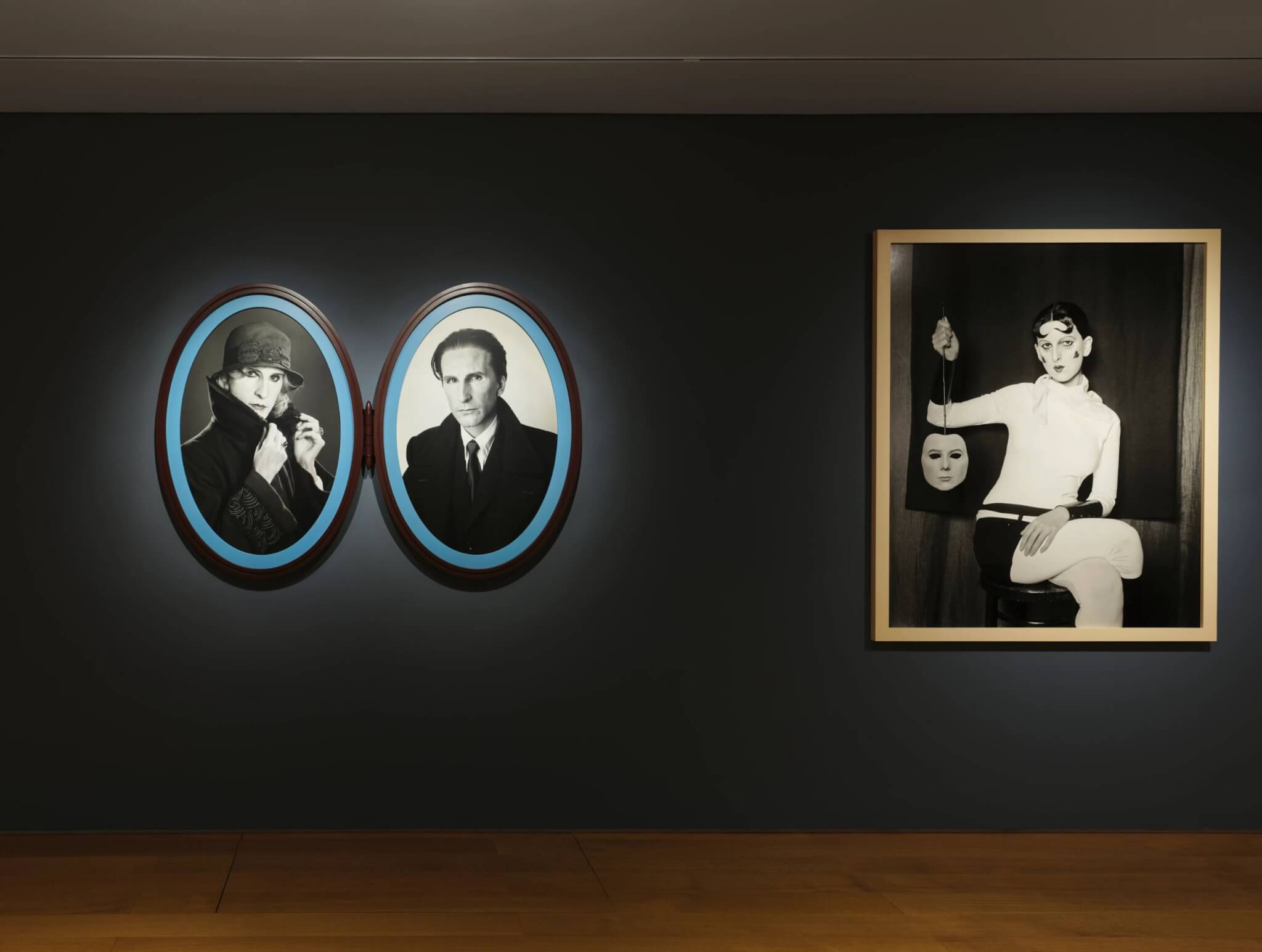
(left) Narcissister, Untitled Self-Portrait Series, 2012. (middle) Gillian Wearing: Me as Madame and Monsieur Duchamp, 2018. (right) Gillian Wearing Me as Cahun Holding a Mask of My Face, 2012. Installation view, “Persona: Photography and the Re-Imagined Self,” 2026. Isabella Stewart Gardner Museum, Boston. Courtesy of the Isabella Stewart Gardner Museum, Boston.
I go to exhibitions to rediscover who I am. It can be worrying—and freeing—this highly sensitized scaffolding of the self, but whenever I’m feeling lost or drained or confused, a visit to a gallery will remind me of the truth of me, with the pieces I love lighting me up like homing beacons back to some fixed core, and those I find challenging constructing new shapes for me to step into. Inevitably, on a later visit, I’ll find that some bit of the show doesn’t fit anymore, that the armature it fastened pinches at the thigh, is too wide at the waist, but even as I settle back into my own size I do so with some greater understanding of my own interior angles. It’s been in pursuit of this insight that I’ve found myself again and again returning to the Isabella Stewart Gardner Museum to witness “Persona: Photography and the Re-imagined Self.”
While it has its roots in the Latin word for stage masks, the term “persona” as we now understand it was coined in 1921 by Carl Jung in his book Psychological Types. It was a concept born from and subsequently strengthened by post-war anxiety. At that particular moment of collective panic and mass solidarity, the persona was the self that one fashioned to align with and thus find security within society. While the persona was necessary to navigate the world, become too attached to it, cautioned Jung, and you lose yourself entirely.
The same year Jung was publishing Types in Switzerland, Dada progenitor Marcel Duchamp was collaborating with Man Ray to produce Belle Haleine (1921), the first photograph of his female alter ego Rrose Sélavy. This initial portrait, which would go on to adorn a perfume bottle in Duchamp’s only surviving assisted readymade, is hanging alongside the more glamorous Rrose Sélavy (Marcel Duchamp) (1923) in the Hostetter Gallery’s darkened antechamber. Just to the right, four photos by surrealist maverick Claude Cahun exemplify just how far artists in the twenties were willing to stray from Jung’s warning. Rather than tentatively don camouflage to conform with society, here was an artist who devoted themselves to their personas so wholeheartedly that they bucked it entirely.
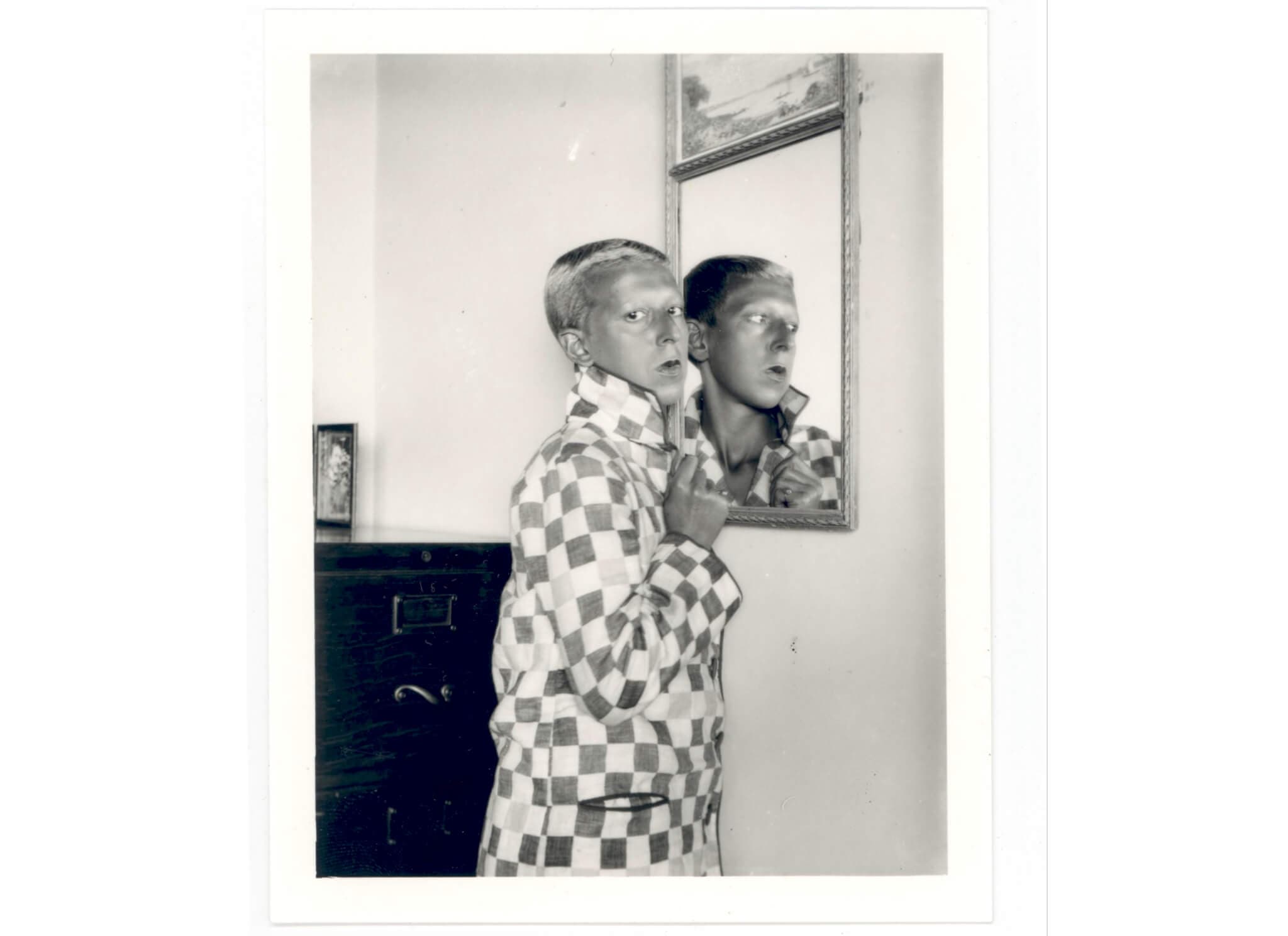
Claude Cahun (French, 1894–1954), Self-portrait (reflected image in mirror, chequered jacket), 1928. Gelatin silver print. Courtesy of the Jersey Heritage Collections.
And we’ve all followed suit. I doubt there’s a visitor to “Persona” that hasn’t dressed up for a selfie. It only took a few months after Louis J.M. Daguerre announced his namesake process for enthusiast Robert Cornelius to stage the first self-portrait daguerreotype in 1839. Now, in the Gardner’s antechamber, we can see just how reflexive this lineage has become. Created nearly a hundred years after the originals, Gillian Wearing’s large reenactments of Duchamp and Cahun in their roles as Selavy and a fabulously androgynous weightlifter (respectively) occupy the opposing wall. In Me as Cahun Holding a Mask of My Face (2012), the artist takes the meta personification one step further, gripping—as the title describes—a lifelike mask of her own face, the eyes darkened and empty while Wearing-as-Cahun holds a steady stare.
The main gallery is dominated by twenty-first-century photography like Wearing’s, though there are some notable exceptions, including the late-seventies series Untitled Film Stills by the grand dame of performative self-portraiture Cindy Sherman, and Carrie Mae Weems’s pentaptych Not Manet’s Type (1997). These photographs are shown together, along with similarly black-and-white works by Zanele Muholi and Lina Geoushy, on the gallery’s right outermost wall. Outermost because the room has been bifurcated by floating walls in the shape of a giant, symmetrical X, skewed a bit on its axis so visitors—regardless of which of the two doors they enter—first encounter not photographs, but rather hazy reflections of themselves and the phrases “Who are you today?” and “Whose shoes do you want to step into?” inscribed at chest height. Unnecessary for a museum-goer with a psyche as malleable as mine, the questions prime viewers made of sterner stuff to recognize the potential of the show to offer an exercise in empathy.
While the exhibition doesn’t make a claim to formal sections, viewers will notice themes within the internal angles of the X; traveling counterclockwise around the room delivers what I’ve dubbed Marriage, Parent/Child, Personas at Large in the IRL World, and Personas at Large in the Digital One.
But let’s orient ourselves by coming back to Weems. If, after gazing at the artist’s bare back, you turn to show her your own, you’ll be confronted with the gallery’s only vitrine. The entry point into the Marriage nook, it holds OMIAI ♥ (2001), ten of Tomoko Sawada’s matchmaking profiles. With their careful poses, they share sympathy with Shigeyuki Kihara’s Ulugali’i Samoa: Samoan Couple (2004-2005), where the artist plays both members of a marriage portrait. In a pointed reversal of traditional Turkish customs, Şükran Moral’s raucous Married with Three Men 01-03 (2010)—in which the older Moral delights in three eighteen-year-old husbands—undercuts the solemnity. Following around to the left, in the Parent/Child area, you’ll catch Jamie Diamond, who is also featured on the museum’s façade, carrying around a heartbreakingly-just-not-quite-realistic-enough baby doll in her I Promise to Be a Good Mother series.
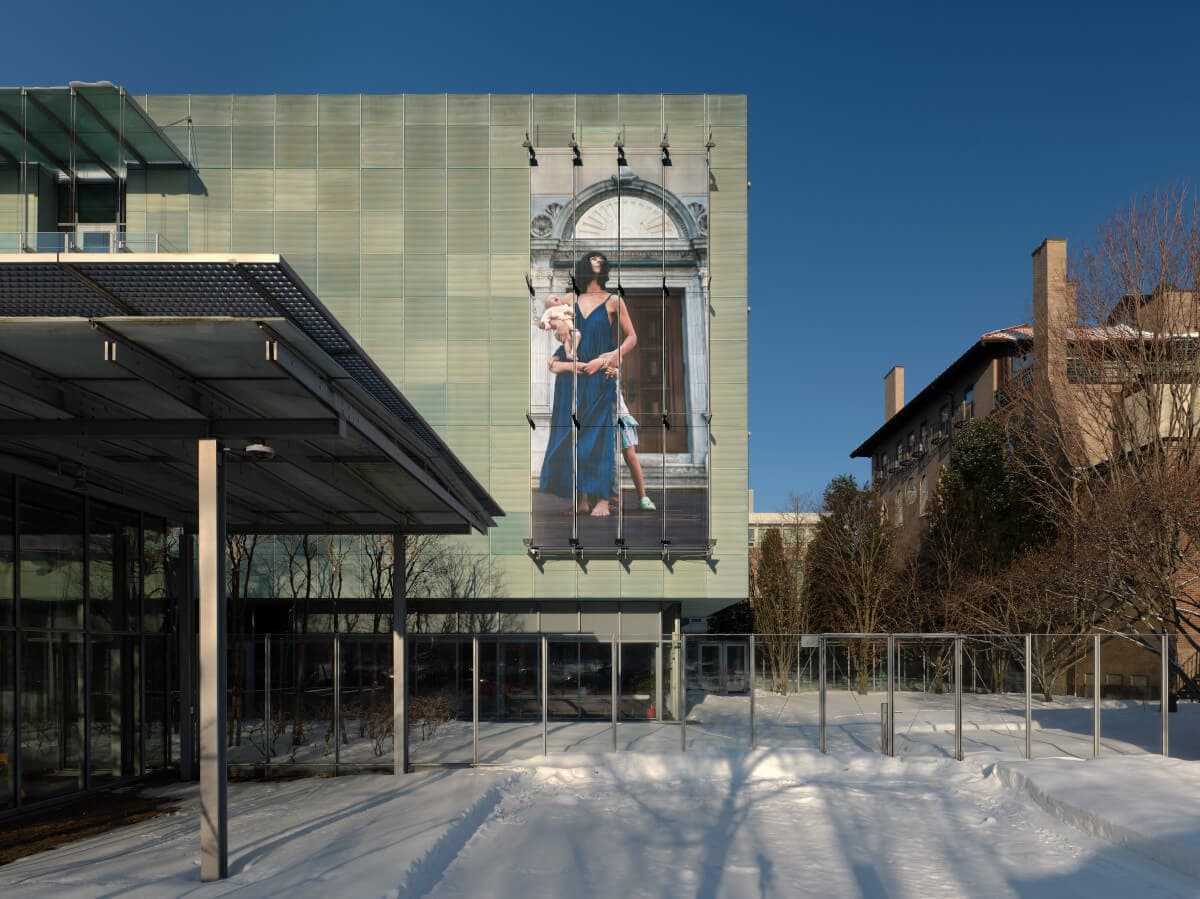
Jamie Diamond, Monstra Te Esse Matrem, 2026, Anne H. Fitzpatrick Façade. Isabella Stewart Gardner Museum, Boston.
In Personas at Large in the IRL World, David Wojnarowicz makes an uncanny appearance as Arthur Rimbaud, the artist-cum-poet popping up around NYC, the alarming flatness of the mask calling to mind early photographic collages by surrealist Dora Maar. Alongside, Tseng Kwong Chi costumes himself in the garb of the Chinese Communist Party to visit Western landmarks such as the Statue of Liberty and the Colosseum. Taken together, the works express both affinity and alienation, a paradoxical relationship that is especially evident in the animated ecosystems of Cao Fei’s chromogenic prints featuring Second Life avatar China Tracy, and in Azra Akšamija’s flickering AI-generated Hallucinating Traditions (2024). This final section depicts the worldbuilding, and subsequently self-building, power of digital tools, and whether you find that concept utopian or dystopian is likely the result of your own relationship to the concept of authenticity—what it consists of, where and how you develop it.
As an elder millennial who remembers life-before-internet, I find that the works discomfit rather than delight, and so with every visit I end up retreating to my own personal bright spots in the far-left corner of the room. Here, Yinka Shonibare takes on one of my favorite literary characters, all brooding and black ink in Dorian Gray (2001). Hakeem Adewumi sprouts hydra heads in Possession of a Recalcitrant Dream (2024) and while he is morphing into a more fantastical version of himself, I return to my own familiar contours. I cast back to 2024, when a brilliant BAR writing fellow, Erwin Kamuene, interviewed Adewumi about this very work for Issue 13.
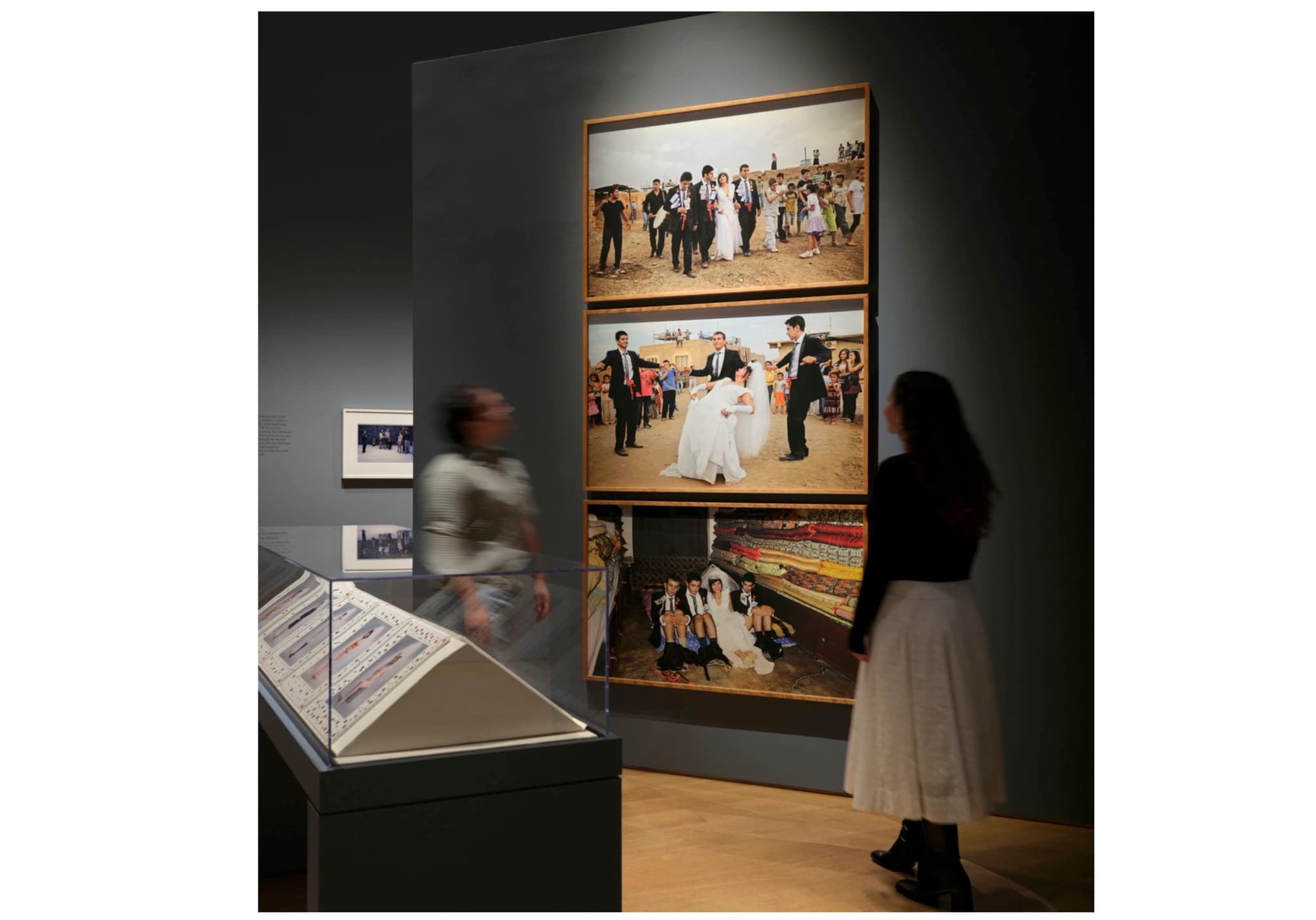
In vitrine: Tomoko Sawada, OMIAI ♥, (2001). On wall: Şükran Moral, Married with Three Men 01 – 03, 2010. Installation view, “Persona: Photography and the Re-Imagined Self,” 2026. Isabella Stewart Gardner Museum, Boston. Courtesy of the Isabella Stewart Gardner Museum, Boston.
In the film stills (2025) of Mary Reid and Patrick Kelley’s The Rape of Europa (2021), I discover evidence of the first video work I saw at the Gardner, when I would return repeatedly to sit in the darkened Fenway Gallery and marvel at the graffitied courtyard and the wide-eyed wrath of the first queen of Crete.
It’s in a small Sophie Calle, however, where I find the earliest, and thus most tender, rendition of me. Titled Coquard (2020), it’s tucked into the “Parent/Child” nook and it’s called the French word for “shiner” because that’s what it is—a depiction of Calle, knees to chin in a bathtub, sporting a black eye. Having just lost her father, she’s encased the image in a wooden box much like a coffin. Etched on its surface is a bit of an explanation. Her father asked her not to cry at his passing, she shares, but life intervened, and after a drowsy domestic accident (running into the “glass roof” of her “garden”) she ended up with this teardrop injury instead.
Life always intervenes. When I was in college, with no galleries or museums in sight, I would construct my self each day in the art stacks. When I discovered Calle’s work in her slick, neon-pink volume Take Care of Yourself (2007), I was both terrified and galvanized by the ways the artist would relinquish control, offer up the reins to fate, and trust in her own resilience to survive whatever situation she found herself in. It’s hardly a skill I’ve mastered, but as I exit “Persona” and catch the question etched into the mirrored edge of the X—“Whose shoes do you want to step into?”—I’m relieved to find that, at some point, the answer has become my own.
“Persona: Photography and the Re-Imagined Self” is on view at the Isabella Stewart Gardner Museum through May 10, 2026.